Stories in History
Indus Valley (Ancient India) Artifacts Activity- Archaeology Lesson for 6th Grade
Indus Valley (Ancient India) Artifacts Activity- Archaeology Lesson for 6th Grade
Couldn't load pickup availability
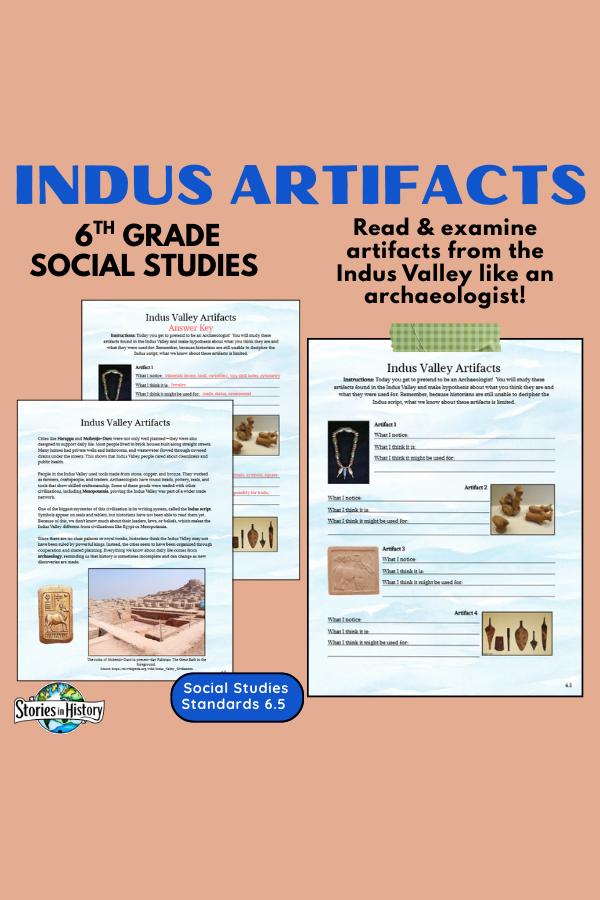
Turn your students into archaeologists with this engaging Indus Valley artifacts investigation activity!
In this hands-on lesson, students explore real artifacts from the Indus Valley Civilization and make hypotheses about what they are and how they were used.
Because historians have not yet deciphered the Indus script, students must rely on observation, evidence, and critical thinking—just like real archaeologists.
Students will:
✔ Examine artifacts from Harappa and Mohenjo-Daro
✔ Identify materials such as stone, shell, copper, bronze, and terracotta
✔ Analyze seals, tools, jewelry, and figurines
✔ Make evidence-based hypotheses
✔ Understand how archaeology helps us reconstruct history
This lesson reinforces the idea that history is sometimes incomplete and can change with new discoveries.
Perfect for:
- Indus Valley units
- Archaeology lessons
- Critical thinking practice
- Inquiry-based learning
- Sub plans
📄 What’s Included
- Informational Reading Passage (Indus Valley daily life & artifacts)
- Artifact Analysis Worksheet (4 artifacts)
- Student Hypothesis Recording Page
- Complete Answer Key
- Print-and-go format
🎓 Grade Level
- Designed for 6th Grade World History
- Works well for Grades 5–7
- Classroom or homeschool friendly
📚 California History–Social Science Standards (Grade 6)
Aligned to:
6.5.1 – Describe the geographic setting and major cities of the Indus Valley
6.5.2 – Discuss trade networks and economic life
6.5.3 – Explain the role of archaeology in understanding early civilizations
6.5.4 – Understand cultural and technological developments
This activity strengthens analysis skills, historical reasoning, and evidence-based thinking.
This is an individual activity from my full-year Ancient Civilizations course. This activity is already included in the full-year course.
Share